^ LISTEN TO THIS ARTICLE by CLICK PLAY ABOVE ^
This article may contain affiliate links, which I do get a commission. I'll only recommend products that I've used and believe in.
OVERTHINKING? 8 Tactical Ways to Silence Mental Noise
How to Stop Rumination, Regain Control, and Build a Disciplined Mind in a Chaotic World
Let’s start with a hard truth:
Most men don’t have anxiety.
You have an undisciplined relationship with your own thoughts.
That doesn’t make you broken. It makes you untrained.
And if you never trained your mind, why would you expect it to behave under pressure?
Overthinking feels intelligent. It feels responsible. It feels like preparation.
But if your thinking does not produce action, it’s not preparation.
It’s avoidance.
You replay conversations. You imagine worst-case scenarios. You rehearse arguments that never happen. You predict rejection before you try. You simulate collapse before you build stability.
Your body reacts like these scenarios are real.
Heart rate rises. Sleep decreases. Energy drops. Confidence erodes.
And nothing actually happened.
That is mental leakage.
The goal isn’t to eliminate thought.
The goal is to control it.
Here’s how you do that.
1. The 10-Minute Worry Window
What This Really Is
You don’t suppress thoughts. Suppression makes them stronger.
What you do instead is contain them.
Your brain keeps bringing thoughts back because it believes they’re unresolved.
So you give it a designated container.
Set a timer for 10 minutes.
During those 10 minutes:
Think about the issue directly.
Write down the fear.
Write down the likely outcome.
Write down the worst-case outcome.
Write down what you would do if that happened.
That’s it.
When the timer ends, you close the session.
Why This Is Important
Without structure, your mind will analyze the same issue 40 times a day.
That’s not intelligence. That’s inefficiency.
By giving yourself a worry window, you’re telling your brain:
“We already handled this.”
This builds authority.
You stop being dragged by thought loops. You start directing them.
2. Write the Thought Once — Then Act Once
The Real Problem With Overthinking
Overthinking thrives in vagueness.
You say: “I’m stressed.” “I don’t know what to do.” “What if this goes wrong?”
That’s fog.
Clarity kills fog.
Take one sheet of paper.
Write the problem in one sentence.
One.
Example: “I’m afraid I’ll fail at starting this business.”
Now underneath that, write:
“What is the next physical action?”
Not the 12-step plan. Not the 5-year vision.
The next move.
Send the email. Research pricing for 20 minutes. Register the domain. Schedule the appointment.
Then execute immediately.
Why This Is Important
Action creates certainty.
Even imperfect action reduces anxiety because your brain now sees movement.
You don’t need confidence first.
You need motion.
Confidence follows evidence. Evidence comes from action.
3. Physical Reset Protocol (Change the Body, Change the Mind)
Why Your Body Matters
Your thoughts are not floating in space.
They are influenced by your nervous system.
If you’re:
Sitting for hours
Overstimulated
Undertrained
Sleep deprived
Overcaffeinated
Your mind will spiral faster.
When you feel mental noise rising, don’t argue with it.
Move.
The 3-Set Reset
Choose one:
Option A: Pushup Reset
3 sets of 20–30 pushups
30 seconds rest between sets
Option B: Sprint Reset
3 rounds of 60-second sprint
Walk back recovery
Option C: Cold Reset
Cold water on face for 60 seconds
3 rounds
Option D: Shadowboxing
3 rounds of 2 minutes
Fast hands, controlled breathing
Why This Works
Movement shifts you from cognitive overload to physical presence.
Your brain cannot spiral at the same intensity when your body is under load.
You interrupt the pattern.
You remind yourself:
“I’m in control.”
Most mental spirals aren’t solved by thinking.
They’re solved by regulating your physiology.
4. Label the Thought: Planning or Ruminating?
The Discipline of Observation
When a thought appears, pause.
Ask:
Is this producing a solution? Or just producing emotion?
Planning results in a next step. Rumination repeats the same loop.
If it’s planning — continue briefly. If it’s rumination — disengage.
Why This Is Powerful
The moment you label a thought, you create distance from it.
Instead of: “I am anxious.”
It becomes: “I’m noticing a rumination pattern.”
That separation restores control.
You are not your thoughts.
You are evaluating them.
5. Reduce Stimulation (Especially Caffeine)
The Hidden Amplifier
Caffeine speeds up mental processing.
That’s fine — if you’re stable.
But if you’re already stressed, caffeine multiplies the noise.
Try this experiment:
For 7 days:
Cut caffeine intake in half.
No caffeine after 12PM.
Notice:
Reduced mental chatter
Better sleep
Less emotional reactivity
Why This Matters
You can’t train a calm mind while constantly overstimulating it.
Discipline is sometimes subtraction.
Less input. Less noise. More control.
6. No Phone for the First 30 Minutes
Protect Your Mental Entry Point
The first 30 minutes after waking are neurologically sensitive.
If you immediately:
Check notifications
Scroll social media
Read news
Reply to messages
You surrender control of your nervous system.
Instead:
For 30 minutes:
No phone.
Drink water.
Stretch.
Sit in silence.
Journal.
Read something grounding.
Why This Changes Everything
Your morning sets your baseline.
If you start reactive, you stay reactive.
If you start grounded, you stay grounded.
You don’t build mental mastery by accident.
You build it intentionally.
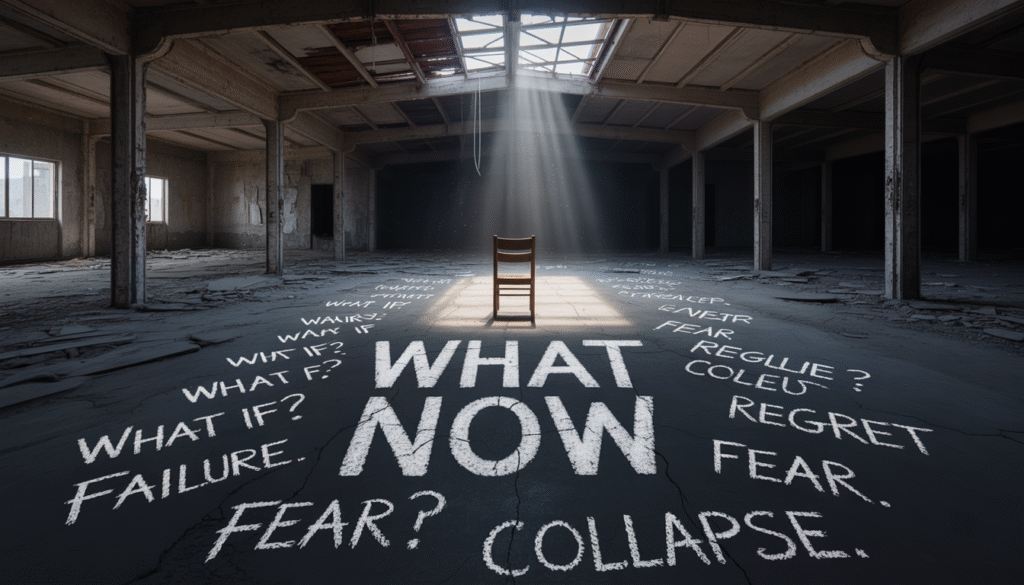
7. Replace “What If” With “What Now”
The Question That Weakens You
“What if I fail?” “What if she rejects me?” “What if society collapses?”
These questions project you into imagined futures.
They create helplessness.
Replace them with:
“What now?”
“What now?” demands action.
It brings you into the present moment.
Why This Works
Fear lives in the future.
Strength lives in the present.
“What now?” forces your brain to search for agency.
And agency kills anxiety.
8. Brain Dump Before Bed
Why Your Brain Won’t Shut Up at Night
Your brain replays thoughts because it doesn’t trust you.
It thinks: “If I stop reminding him, he’ll forget.”