Look, I’m gonna say something that might sound crazy at first, but stay with me for a second.
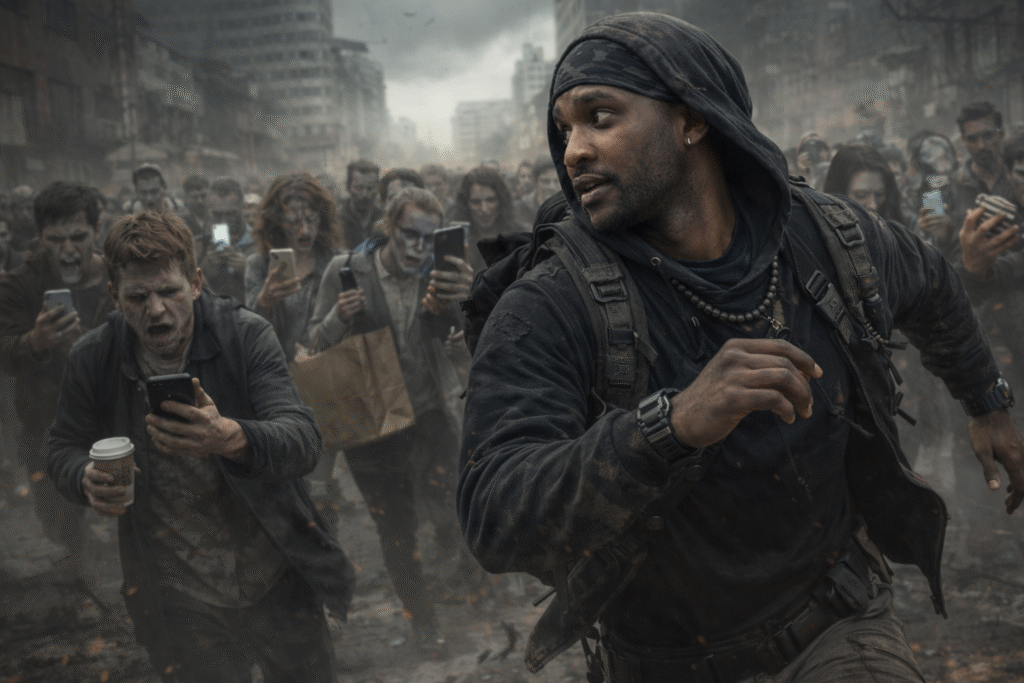
If you’ve ever watched something like The Walking Dead or played a game like Resident Evil, you know the classic zombie apocalypse formula. Civilization collapses, people panic, the infected shuffle around in a mindless herd, and the small group of survivors has to think differently if they want to make it.
Now here’s the wild part.
If you pay attention to how a lot of people move through life today… it starts to look very similar.
Look, I’m not saying there’s a virus turning people into flesh-eating monsters. What I am saying is that the mindset we see in zombie stories — the herd mentality, the lack of awareness, the dependence on systems — is already happening for real for real.
And if you’re one of the survivors you can see it clearly.
And also, in every zombie story, the biggest threat isn’t always the zombies.
Sometimes it’s the people who refuse to wake up.
1. Zombies Follow the Herd — Most People Do Too
In almost every zombie movie, the zombies move in groups. They don’t think independently. They follow noise, movement, and whatever the crowd is doing.
Sound familiar lol?
A lot of modern life is basically herd behavior on autopilot.
People follow trends without questioning them.
They’ll repeat opinions they heard five minutes ago.
They move wherever the algorithm, the news cycle, or the crowd pushes them.
And the problem with herd thinking is simple:
When the herd runs off a cliff… everybody goes.
A survivor learns to step outside the herd mentality.
That means asking questions.
Thinking for yourself.
And not automatically assuming that the crowd is right.
Tip
Practice making independent decisions without waiting for social approval, which will probably end badly anyway.
Why Does This Even Matter?
In real emergencies — whether it’s a blackout, a riot, or a disaster — people who wait for the herd to tell them what to do are usually the last to act.
And in survival situations, late action can mean no action at all.
2. Zombies Are Distracted by Noise — Modern People Are Distracted by Screens
I’m tell you, watch any zombie movie and you’ll notice something.
A loud sound — a gunshot, a car alarm, breaking glass — pulls the entire horde toward it.
A zombies attention is easily hijacked.
Now think about the way people act in real life.
Phones buzzing.
Notifications popping.
Endless scrolling.
The average person checks their phone hundreds of times a day, and most of that information has zero positive impact on their real life.
Distraction is one of the biggest weaknesses in survival.
If you’re mentally somewhere else, you’re not aware of what’s happening around you.
Tip
Start looking up from your phone and scan your environment regularly.
Why It Matters
Situational awareness is one of the most important survival skills there is. Most threats are avoidable if you notice them early.
3. Zombies Consume Without Thinking
Another classic zombie trait is their mindless consumption.
They wander around endlessly trying to feed.
Now translate that into modern life.
A lot of people spend their days consuming:
Content
Food
Products
Entertainment
But they rarely create anything.
Most people rarely build skills.
They rarely ask themselves whether what they’re consuming is actually helping them grow.
A survivor mindset is gonna flip that completely.
Instead of asking:
“What can I consume today?”
You start asking:
“What can I build today?”
Tip
Balance every hour of consuming content with spending time creating, learning, or training.
Why It Even Matters
It’s gonna be skills not consumption that’s going to keep people alive when systems fail.
4. Zombies Ignore Danger Until It’s Too Late
In most apocalypse stories, the outbreak spreads because people ignore the warning signs.
Someone messes around and gets bitten.
Someone feels sick.
Someone says, “It’s probably nothing.”
Next thing you know BAM… the entire city is overrun.
Humans have a psychological tendency called normalcy bias.
It basically means people will assume things will keep working the way they always have — even when there are clear signs that they might not.
That’s why a lot of people don’t prepare for emergencies.
They assume someone else will handle it.
Tip
Adopt the mindset: prepare early, not urgently.
Why It Matters
Preparation always feels unnecessary… right up until the moment it becomes essential, so don’t get caught lacking.
5. Survivors in Zombie Stories Are the Ones Who Adapt
Here’s the part people forget about zombie movies.
The survivors who make it usually aren’t the strongest people.
They’re the most adaptable.
They do things like learn new skills, improvise and change strategies when things stop working.
That’s the real lesson hidden inside every apocalypse story.
The world changes constantly. Technology, systems and even the economies can change.
The people who thrive aren’t the ones who cling to the old way of doing things.
They’re the ones who adapt faster than everyone else.
Tip
Challenge yourself regularly to learn skills outside your comfort zone.
Why It Matters
Adaptability is the ultimate survival skill.
6. Survivors Build Small Tribes — Not Massive Crowds
One of the most consistent themes in stories like The Walking Dead is that survivors eventually form small communities.
Not giant crowds.
Small, tight-knit groups where everyone contributes.
That’s because survival isn’t really a solo game.
You need people with different skills:
Fighters
Medics
Builders
Scouts
The key is building a trustworthy tribes, not chasing popularity, it’s about quality over quantity.
Tip
Focus on building relationships with people who value skills, loyalty, and preparedness.
Why It Matters
In hard times, your network often determines your survival odds.
7. Awareness Is What Separates Survivors from Zombies
At the end of the day, the biggest difference between zombies and survivors is simple.
Awareness.
Zombies move through the world unconsciously.
Survivors pay attention.
Survivors will notice patterns.
They’ll prepare for possibilities.
They’ll think about consequences before things happen.
That awareness applies to everything:
Personal safety
Financial independence
Mental health
Preparedness
When you realize how systems actually work, you start moving differently.
And that’s when you stop being part of the horde.
The Hard Truth
This isn’t about insulting people.
It’s about waking up and decoding the system.
A lot of people drift through life on autopilot. They’ll start following trends, they’ll consume nonstop entertainment, ignore all the warning signs, and assume the system will always protect them like some kind of superman.
That’s the closest thing to a real zombie apocalypse we have.
Mindless living.
The good news?
You don’t have to be part of it.
You can choose to be the person who thinks, prepares, trains, and builds real-world skills.
That’s what being an urban warrior is all about and why I started doing this content to help you get there faster.
And in a world full of zombies be on of the survivors…
Awareness and adaptation is your survival weapon.
Call to Action
If you want to go deeper into the survival mindset behind this episode:
Download the full podcast episode on Spotify, join the Urban Warrior Survival Discord, and sign up for the newsletter to get the Urban Survival Checklist.
Because awareness is step one.
Preparation is step two.
And the people who start now are the ones who won’t panic later.